Come see my works in RAA's spring exhibition. Refreshements will be provided. Gallery is open on Saturdays and Sundays from 12-4pm. Hope to see you there!
DIRECTIONS
By Car
From Belt Parkway, Exit 11S, go straight across Marine Parkway Bridge, stay right, follow sign to Breezy Point off bridge. Make left into park at first traffic light.
From Woodhaven Blvd. to Crossbay Blvd. Go over Crossbay Bridge, go west on Beach Channel Drive. Follow sign to Breezy Point (bear right). Make left into park after first traffic light (Just past the entrance to the Gil Hodges Memorial Bridge).
By Public Transportation
From the Flatbush Ave/Brooklyn College subway stop (2 and 5 subway lines) take the Q35 to Fort Tilden. From Beach 116th Street, take the Q35 or Q22 to Fort Tilden.

Anne Frances Clinton is a student at the School of Visual Arts. She enjoys creating fine art using a variety of different media.
Showing posts with label Art. Show all posts
Showing posts with label Art. Show all posts
Friday, May 6, 2011

Nature: Fur, Flora, and Feathers (May 21-June 26, 2011)
Come see my works in RAA's spring exhibition. Refreshements will be provided. Gallery is open on Saturdays and Sundays from 12-4pm. Hope to see you there!
DIRECTIONS
By Car
From Belt Parkway, Exit 11S, go straight across Marine Parkway Bridge, stay right, follow sign to Breezy Point off bridge. Make left into park at first traffic light.
From Woodhaven Blvd. to Crossbay Blvd. Go over Crossbay Bridge, go west on Beach Channel Drive. Follow sign to Breezy Point (bear right). Make left into park after first traffic light (Just past the entrance to the Gil Hodges Memorial Bridge).
By Public Transportation
From the Flatbush Ave/Brooklyn College subway stop (2 and 5 subway lines) take the Q35 to Fort Tilden. From Beach 116th Street, take the Q35 or Q22 to Fort Tilden.
DIRECTIONS
By Car
From Belt Parkway, Exit 11S, go straight across Marine Parkway Bridge, stay right, follow sign to Breezy Point off bridge. Make left into park at first traffic light.
From Woodhaven Blvd. to Crossbay Blvd. Go over Crossbay Bridge, go west on Beach Channel Drive. Follow sign to Breezy Point (bear right). Make left into park after first traffic light (Just past the entrance to the Gil Hodges Memorial Bridge).
By Public Transportation
From the Flatbush Ave/Brooklyn College subway stop (2 and 5 subway lines) take the Q35 to Fort Tilden. From Beach 116th Street, take the Q35 or Q22 to Fort Tilden.
Sunday, February 6, 2011


Saturday, January 29, 2011


Wednesday, January 12, 2011

Tuesday, January 4, 2011


Monday, January 3, 2011
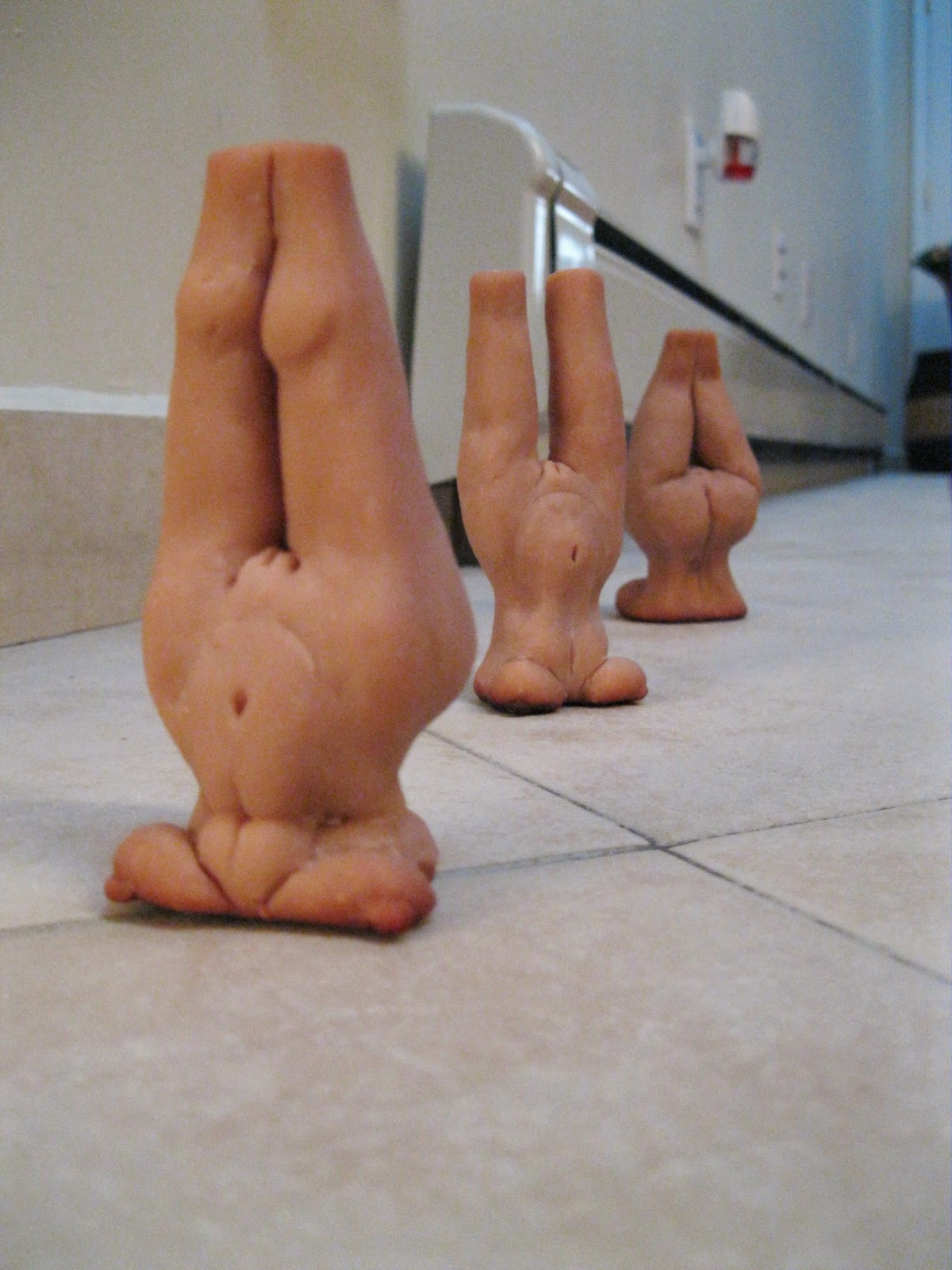


Amenorrhea (5)


Using impermanent materials: oil based clay, paper, and roots, I molded a life size bust of myself. The face retains a peaceful expression while the body is made out of growing orchids and roots. The cavity in the center of the chest, were breasts should be, alludes to a suppressed maturity. Except for the platform, the entire piece is painted black to reflect on the eventual decomposition of the piece and the body it represents.
Sunday, January 2, 2011
Should Photography be Considered Fine Art?
 |
| Sherman, C. Untitle #225 Retrieved from http://www.cindysherman.com/art.shtml, Retrieved on January 9, 2011 |
![Untitled [You are a captive audience]](https://lh3.googleusercontent.com/blogger_img_proxy/AEn0k_vItGkbIQMhh49dSflwzmiqsRWqNC6A6IKBCuwuNsdkPFFM_tn9UG7fxLYQtUkdGkSLX1IvHrYvt9hCWJ7Ug0NY1oRrvtJngDCy7sLhxTM=s0-d) |
| Kruger, B. (1992). Untitled (“You are a Captive Audience”) Retrieved from http://www.geh.org/taschen/htmlsrc15/m199203790001_ful.html Retrieved on January 9, 2011 |
By: Anne Frances Clinton Ó 2011
Is photography art? This question is heavily debated amongst artists because of the boundaries of fine art and photography have blurred. The main objection seems to be that photography is done by a machine and that the user has nothing to do with it. However, when we look at the work of Barbara Kruger and Cindy Sherman, fine artists in their own right, we see how they have used photography as an alternative way to express themselves.
In order to be considered a fine artist, one must express themselves visually - so photography by definition would be considered fine art. For example, Barbara Kruger has used text over black and white photographs so she can highlight her message. She has addressed issues on feminism, consumerism and the like. In one of her two pieces entitled, You Are a Captive Audience (1992), her words are superimposed over a man placing a wedding ring on a woman’s finger. Kruger’s hidden feminist message of immobility of women within marriage becomes more obvious to the viewer. Kruger uses photographs as the canvas to showcase her ideas and not as a primary means to express herself. In this case, photographs are only another tool that is used.
On the other hand, Cindy Sherman uses photography as her primary media to carry a similar message. Her work often criticizes the concept that women are merely objects for men’s entertainment. This point is most evident in her series of photos with mannequins in sexually explicit positions. This series of photographs solidified Sherman’s place as a feminist. Unlike Kruger, Sherman’s art is the photograph, which she uses to get her message across.
Both artists use photographs in different ways to visually express their emotions, feelings and opinions. However, how they applied the technique is different. Kruger used the photograph as a backdrop for her art, as Sherman used it as her art. Both techniques seem to work. In the end, art is in the eye of the beholder and it all depends on who, where and how it is viewed.
Wednesday, November 3, 2010
Amenorrhea 4

.JPG)
In this piece, the seashells, blood and a menstrual pad on a circular shaped canvas, refer to my inability to obtain a normal menstrual cycle.
Wednesday, October 27, 2010
Amenorrhea 3
Drawing/Quilt
.JPG)
.JPG)
Within this piece are five drawings of the inside of a pomegranate which symbolizes the early stages of the menstrual cycle. Menstruation, the process where blood exits the body, is also depicted by the red painted branches of a pomegranate shrub peeking through the brown ones. As the viewer progresses clockwise, the drawing portrays the decaying process of the fruit, which implies the absence of menstruation. The continuation of this unusual condition is reflected by the circular shape of the piece. Finally, I tied these series of representations together by sewing the drawings into one and trimming the piece in lace, making it a quit as well as a drawing.
Amenorrhea 2

.JPG) |
From a distance, one may suspect they are viewing a simple arrangement of colorful seashells, however they are not. Upon closer inspection, the viewer can plainly see that the shells are actually set upon a menstrual pad floating inside of a toilet. The shells portray feminine sexuality since their forms curve inward, resembling female genitals. Before the viewer realizes it, they have become a voyeur. From the opening of the conch shell, a small splat of blood, instead of the usual flow, hints to a lack of menstruation. The oval contour of the drawing plays off the shape of a toilet seat, completing the piece.

Wednesday, October 20, 2010
Tuesday, October 19, 2010



Friday, October 15, 2010
Amenorrhea (6)

.JPG)
.JPG)
.JPG)
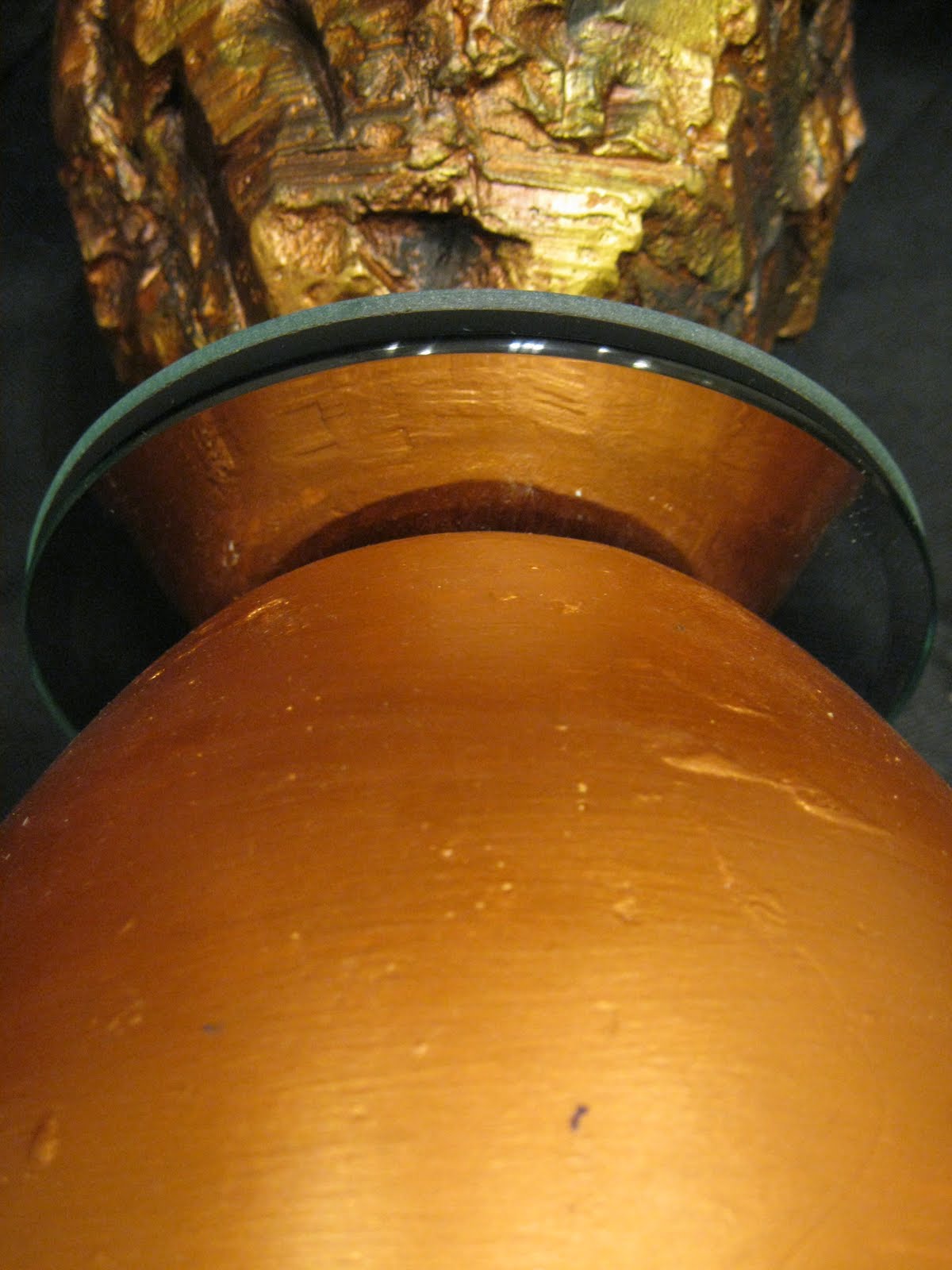
.JPG) At first glance this sculpture appears to be a decorative object – an object to be admired. From this perspective, the viewer observes the piece the same way countless teenage girls want to be perceived. Because of society’s view on what is to be admired, many girls try to transform their bodies into the ideal appearance. However, when the golden lid is removed, the viewer is presented a grotesque cluster of bones and bodily organs. The viewer is now faced with the reality that society’s view has damaged many a girl’s physical as well as psychological well being all in the pursuit of what is to be admired.
At first glance this sculpture appears to be a decorative object – an object to be admired. From this perspective, the viewer observes the piece the same way countless teenage girls want to be perceived. Because of society’s view on what is to be admired, many girls try to transform their bodies into the ideal appearance. However, when the golden lid is removed, the viewer is presented a grotesque cluster of bones and bodily organs. The viewer is now faced with the reality that society’s view has damaged many a girl’s physical as well as psychological well being all in the pursuit of what is to be admired.
Subscribe to:
Posts (Atom)